Use cases › Service Desk Copilot
Service Desk Copilot
An IT service desk Solution with a Teams assistant, live ServiceNow incident data, a SAML-protected dashboard and automatic P1 alerts.
- Everyone
- Functional users
Last reviewed
Harbourline Energy (a fictional regional energy distributor with 2,000 staff) runs its IT service desk on ServiceNow. Employees work in Microsoft Teams. The company signs everyone in through its own SAML identity provider. This use case shows how Harbourline builds a Service Desk Copilot in Flexday AI: an assistant in Teams, a live dashboard for IT, and automations that keep everything in step with ServiceNow.
Note
In one sentence: ServiceNow stays the system of record for incidents; Flexday AI adds a Teams assistant that resolves or raises tickets, a live incident dataset and dashboard, and alerts that reach people where they work.
The problem
| Pain | Effect |
|---|---|
| Simple questions reach the service desk | Analysts spend the first hour of the day on password and VPN questions the knowledge base already answers. |
| Tickets arrive incomplete | Analysts go back to the caller for the site, the device and what they already tried. |
| No live picture for managers | SLA risk and P1 incidents are found by running ServiceNow reports by hand. |
| P1 alerts are slow | The on-call engineer hears about a priority 1 incident from a phone call. |
What Harbourline builds
| For | What they get |
|---|---|
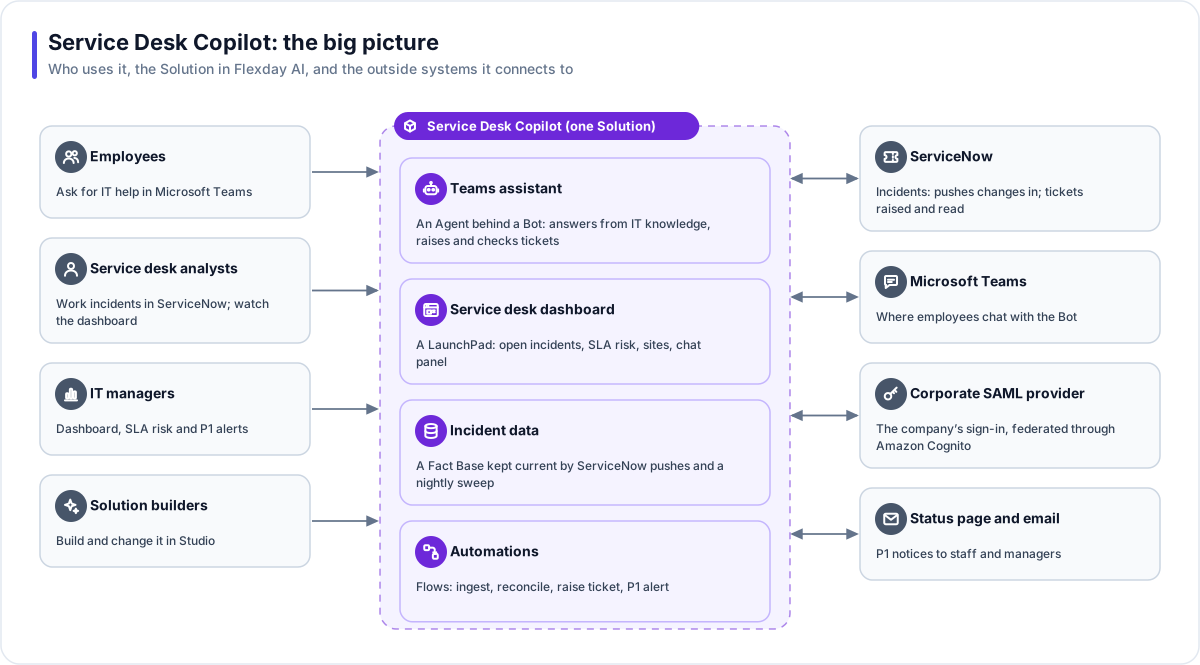
| Employees | A Teams assistant that answers from Harbourline's own IT knowledge, with the articles it used. When a fix does not work, it gathers the details and raises the ticket, and it reports a ticket's status by its number. |
| Service desk analysts | Tickets that arrive complete, and fewer of them. |
| IT managers | A dashboard of open incidents by priority, SLA risk and site, with a chat panel that can also search internal runbooks. |
| On-call engineers | A Teams message the moment a P1 incident is raised. |
How it fits together
- ServiceNow pushes every incident insert and update to a flow endpoint protected by an API key. A Flow saves it into a Fact Base. See data flow 1.
- A nightly Flow pulls open incidents with the Integration step and corrects anything a push missed. See data flow 2.
- The Teams assistant is an Agent behind a Bot. It searches a Doc Base of IT knowledge and runs a Flow to raise tickets. See data flow 3.
- A P1 alert Flow messages on-call engineers in Teams, updates the status page using a Secret Variable, and emails managers. See data flow 4.
- The dashboard is a LaunchPad whose users sign in through the company's SAML provider, federated through an Amazon Cognito user pool. See Authentication.
Outcomes Harbourline measures
| Measure | Where it comes from |
|---|---|
| Questions resolved without a ticket | Agent analytics: conversations that ended without running the Raise incident Flow |
| Tickets raised complete | ServiceNow: tickets raised by the Flow carry site, category and the steps tried |
| Time to P1 acknowledgement | ServiceNow timestamps against the Teams delivery records |
| Cost per month | The Solution's Usage view: every model call, attributed to this Solution |
Why this is a good fit for Flexday AI
- It extends ServiceNow rather than replacing it. Tickets are still created and worked in ServiceNow; Flexday AI adds the conversation, the live view and the automation.
- It is governed from day one. Every credential is sealed, no ticket write is repeated, every change is audited, and the assistant can only use the tools it is granted.
- It is built by conversation. The Builder creates most of it from a description and a sample export, and the team configures the rest in Studio. See Build and operate.